The Experian Small Business Index™ declined month-over-month by almost 12 points.
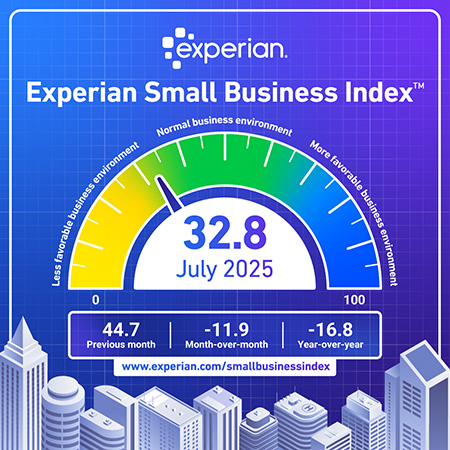
July 2025
- Index Value (Jul):32.8
- Previous Month:44.7
- MoM:-11.9
- YoY:-16.8 (Jul 2024 = 49.6)
The Experian Small Business Index™ declined in July to 32.8, down 11.9 points. Small businesses still look healthy, but business owners are starting to show some stress in their consumer credit profiles. The primary driver was tighter lending conditions, which reduced approval rates and increased delinquencies for consumers. Pressure has built on the small business owner due to rising student loan defaults and a softer labor market, which is beginning to erode consumer credit health.
Inflation has remained even, with slight upticks in some sectors and slight decreases in others. Rent inflation continues a downward trend; it was 3.8% in June, down from 3.9% in May. Producer price inflation was also down 0.4 points to 2.3%, reaching its lowest level since September 2024. Some sectors had inflation rise, with food inflation up slightly from May to 3.0% from 2.9%, overall inflation was up 2.7% in June from 2.4% in May, and core inflation increased from 2.8% in May to 2.9% in June. The savings rate decreased to 4.5% in May, down from 4.9% in April, as consumers continue to spend.
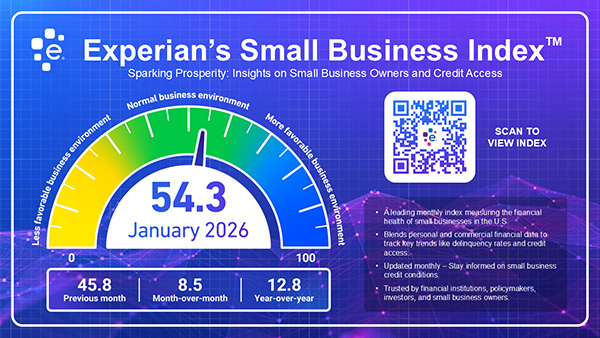
The Experian Small Business Index™ rebounded by 8.5 points month-over-month, remains up by 12.8 points Year-Over-Year Jan 2026 Index Value (Jan): 54.3 Previous Month: 45.8 MoM: 8.5 YoY: 12.8 (Jan 2025 = 41.5) The Experian Small Business Index™ increased 8.5 points to 54.3 in January. This is 12.8 points higher than it was a year ago. The improvement coincided with declines in certain risk indicators, including utilization and overdue balances, alongside increased demand for and access to new credit. At the same time, some risk factors warrant continued monitoring, as later delinquencies on commercial trades and early-stage delinquencies on consumer trades ticked upward. Several macroeconomic indicators improved in January, including inflation and labor market measures. Inflation decreased from 2.7% in December to 2.4% in January, the lowest since May 2025. Core inflation was down from 2.6% to 2.5%, the lowest since March 2021. The U.S. economy added 130K jobs in January, and unemployment ticked down to 4.3% from 4.4%. Some indicators, however, pointed to ongoing economic pressure. The PCE price index increased slightly in December to 2.9% from 2.8%, remaining above the Federal Reserve’s 2% target. Personal savings also fell for the eighth consecutive month as households continue to face higher prices. Consumer interest in new business formation remained elevated, with 532K new business applications filed in January. Explore Experian Small Business Index Related Posts
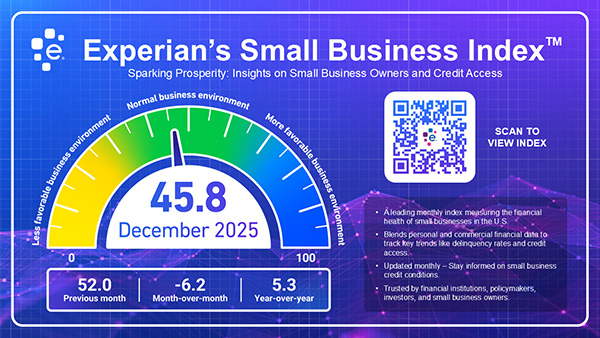
The Experian Small Business Index™ declined by 6.2 points month-over-month, remains up by 5.3 points Year-Over-Year Dec 2025 Index Value (Dec): 45.8 Previous Month: 52.0 MoM: -6.2 YoY: 5.3 (Dec 2024 = 40.5) The Experian Small Business Index™ decreased 6.2 points to 45.8 in December, which was 5.3 points higher year-over-year. The monthly decrease coincided with increases in certain business risk indicators, including higher delinquency rates and rising balances, alongside a reduction in new credit activity, suggesting a tighter lending environment. Broader economic conditions remained stable in December. The unemployment rate edged down to 4.4% from 4.5%, while inflation trends were mixed. Energy price inflation declined, the producer price index remained flat, and rent and food inflation increased. These conditions contributed to the Federal Reserve’s decision to maintain interest rates at its January meeting. Small businesses and consumers both showed improved optimism with both the NFIB Small Business Optimism Index and the University of Michigan Consumer Sentiment Index recording increases in December. Explore Experian Small Business Index Related Posts
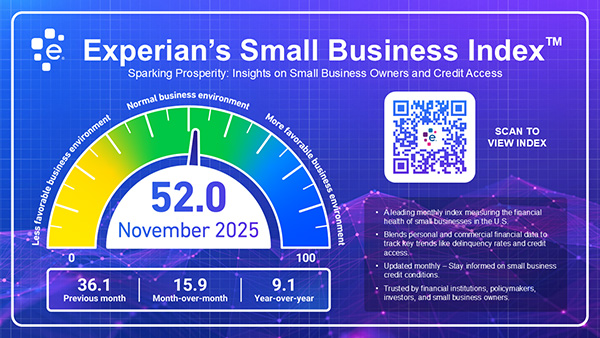
The Experian Small Business Index™ improved by 15.9 points month-over-month and 9.1 points Year-Over-Year Nov 2025 Index Value (Nov): 52.0 Previous Month: 36.1 MoM: 15.9 YoY: 9.1 (Nov 2024 = 42.9) The Experian Small Business Index™ increased substantially in November by 15.9 points to 52.0. This also represents a YoY increase of 9.1 points. There was increased business activity with the end of the government shutdown in November. Business owners saw an increase in new account openings and approval rates, along with an increased number of new business formations. Negative credit conditions improved, with reductions in delinquencies and utilization. The Small Business Optimism Index from NFIB increased to 99.0 from 98.2 in October. There was an increase in the number of new business applications to 535K from 499K in October, the most in a single month since July 2020. Inflation fell in November, to 2.7% from 3.0% in September, the lowest level since July. November unemployment was up to 4.6% from 4.4% in September. The inflation and unemployment rates are likely to influence Federal Reserve policy decisions as they consider whether additional rate cuts are warranted in 2026 after a 25 bps drop in December. Explore Experian Small Business Index Related Posts